

Volume 5 Issue 1, Review
Tome 5 numéro 1, Critique
Review by Brooks DeCillia
REVIEW | CRITIQUE
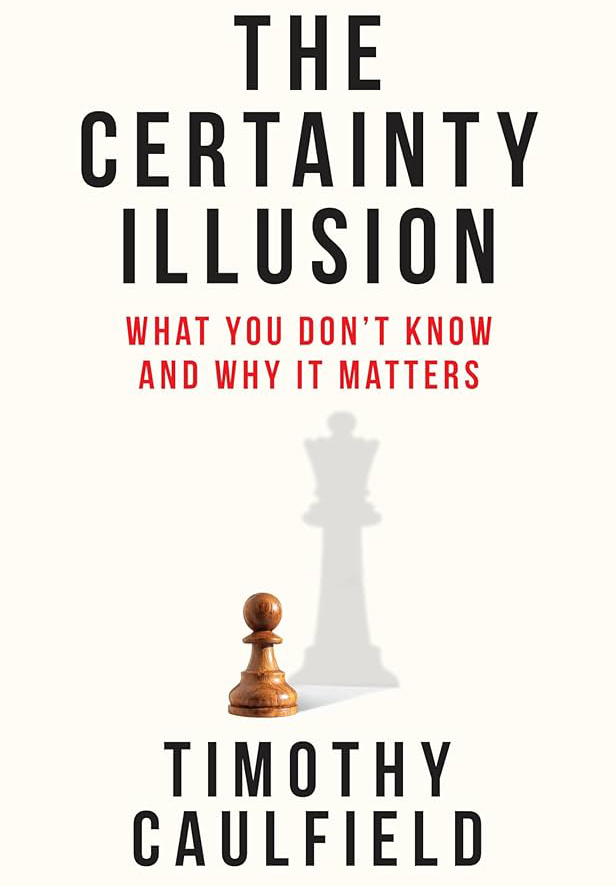
The certainty illusion: What you don’t know and why it matters
Timothy Caulfield
Penguin Random House Canada, 2025
(312 pp.) paperback, hard cover, e-book, audio book
Review by Brooks DeCillia
If Timothy Caulfield weren’t a legal scholar and an internationally renowned crusader against junk science and online misinformation and disinformation, he could be a journalist.
His latest book, The Certainty Illusion: What You Don’t Know and Why it Matters, offers a “how-to manual” for reporters to live up to that old journalism axiom: “If your mother says she loves you, check it out!”
Caulfield’s fifth book, which explores how hype, manipulation, and deception distort our understanding of science and health, prescribes a healthy dose of skepticism and critical thinking to navigate our current “information disorder” (Wardle, 2020, para. 1).
In an age of information abundance, Caulfield, a University of Alberta law professor and former Canada Research Chair in Health Law and Policy, concedes it is, indeed, getting harder to sort fact from fiction. Caulfield admits that even after decades of analyzing and critiquing biomedical and health research, he, too, is “finding it more difficult to separate good stuff from the marginal and the full-on manure” (Caulfield, 2025, p. 232).
In an interview last year, Caulfield called the spread of misinformation and disinformation “one of the greatest challenges of our times” (DeCillia, 2024, 0:44).
His new book exposes the forces contributing to what some have dubbed the “age of information disorder” (Wardle, 2025, para 1). It offers valuable tips for pushing back on the bad actors peddling misinformation and disinformation.
The Certainty Illusion warns about three fallacies that perpetuate fake news and misinformation:
The “science illusion”
The “science illusion”—with its critique of “scienceploitation” and “science washing”—warns about the sloppy and sketchy science used to manipulate consumers to buy dubious products and peddle false claims about everything from health benefits to climate-change denial (Caulfield, 2025, pp. 12, 34). All too frequently, “scienceploitation” occurs when scientific ideas in our zeitgeist (think stem cells and quantum physics) get misused to sell potentially harmful products and services.
Science washing, on the other hand, embellishes scientific findings, “using science in areas where science can’t tell you the answer,” “making claims beyond what the evidence shows,” and often eagerly “accept[s] claims that seem scientific without critical appraisal,” as Michelle Wong, a cosmetic chemist helpfully defined it on her digital platform Lab Muffin Beauty Science (Wong, 2019, paras. 4-5).
Sadly, this junk science frequently makes its way into the news media.
The “goodness illusion”
Caulfield continues the critique of celebrity health endorsements that he began in his 2015 book, The Science of Celebrity … or Is Gwyneth Paltrow Wrong About Everything?, with an equally damning appraisal of the so-called “goodness illusion,” whereby just about every product and service comes crowned with often misleading and meaningless “health halo” labels such as “clean,” “natural,” “vitamin-fortified” or “organic” (Caulfield, 2025, p. 15). This framing, Caulfield stresses, preys on our fears and desires to do good.
The “opinion illusion”
Finally, the “opinion illusion”—encompassing our ever-expanding opinion economy, with fake restaurant and hyperbolic Amazon product reviews—seduces us into buying things based on dubious claims and leads us yearning to dine in a faux restaurant located in a shed in north London (p. 171). In our quest to be discerning consumers and stylish restaurant-goers, Caulfield writes, we have become increasingly reliant on opinion polls, tastemakers, aggregators, and fabricated reviews increasingly generated by artificial intelligence.
Seeing past the illusions
The way to see past these illusions, Caulfield argues, requires good old-fashioned critical thinking and skepticism—hallmarks of good journalism.
Caulfield offers six practical tips for consumers to protect themselves against being duped by misinformation and disinformation. And while many journalists are trained critical thinkers with solid verification and fact-checking skills, Caulfield’s tips offer a good reminder for working journalists—and a good starting point for journalism students—to combat misinformation and disinformation.
1. Recognize the information disorder, or what U.K. journalist Peter Pomerantsev (2019) calls “censorship through noise,” the communications environment in which we currently operate. To that end, we need to pause and “recognize the information ecosystem isn’t rigged for accuracy,” forewarns Caulfield (p. 228). Admittedly, this is not easy! In the introduction to his book, Caulfield concedes that we “are bombarded with information through our smartphones, tablets, TV shows, and internet searches” (p. 13). He points out that we process a dizzying 74 gigabytes of information daily, the equivalent of what neuroscientists estimate a highly educated person consumed in their lifetime five hundred years ago (p. 13).
“It is now a truism,” Caulfied cautions, “that a host of factors—including social media and search engine algorithms, the polarization of and politicization of science and opinion and old-school marketing tactics–are the enemy of accuracy” (p. 228). The world-leading thinker about misinformation and disinformation advises listening to our “Spidey senses” and relying on evidence-based information, another hallmark of journalism (p. 228).
In recognizing our information disorder, journalists should also remember that many politicians are working at cross-purposes to the truth, or, as journalism scholar Jay Rosen calls it, “verification in reverse,” to describe the “performative lying [that] authority figures” do to advance their agenda (cited by Jacob, 2025, para 3). In this new misinformation milieu, linguist and proponent of the fact-checking truth sandwich, George Lakoff, contends that journalists should go beyond simply setting the record straight with fact-checking and also expose the sometimes-hidden agenda behind the bad actor’s disinformation (King, 2017).
Rosen, who is troubled by the democratic backsliding in the United States where he works and lives, also wants journalists to aggressively push back on multiple fronts, including “digging for information, asking blunt questions (when they are good questions), even if that might endanger a reporter’s future access. Aggressive, too, in warning the Republic that its democracy is under attack, and bringing attention to that warning by use of every media platform available” (Jacob, 2025, para 20).
2. Watch for “scienceploitation.” Check and test the accuracy of the information, guarding against the malicious agenda of bad actors perpetuating these persuasion scams (Caulfield, 2025, pp. 29-30).
A “discipline of verification,” journalism not only relies on facts to tell stories, but also work to expose the “truth about the facts” (Rosenstiel, 2025, para 1). The longtime law professor and health researcher offers solid advice for news consumers and also for reporters who constantly seek fresh angles to please their editors: “Be extra suspicious of claims that use hot topics” (Caulfield, 2025, p. 229). Don’t buy the hype about, among other things, stem cells, regenerative medicine, genomics and quantum physics. Always ask whether scientific claims are backed by peer-reviewed research or merely adorned with sciency language and buzzwords.
3. Resist the allure of science This is also an essential warning for reporters on the science and technology beat. To cover science, journalists need to know how science—and the scientific method—work. The process is slow and iterative. “Science is super hard!” Caulfield cautions (p.230).
Just as we judge the credibility of social media, journalists must also scrutinize the quality and sources of scientific evidence and research. Science, we must remember, is not free of error, bias, or misconduct. Plus, “exaggeration and overly optimistic claims of near-future benefits have become the norm,” warns Caulfield (p. 230). On top of that, the current system “incentivizes both quantity-over-quality research advances and hype about those small advances,” writes Caulfield (p. 230, italics in original). As journalists, we must pay attention to the reality that turning groundbreaking research from the laboratory, even those promising clinical trials, “is a fraught, uncertain, and usually unsuccessful enterprise” (p. 230). In some good advice for journalists, Caulfield warns against overemphasizing unpublished research or research published in predatory or fake journals. While it can be challenging to assess the quality of a publication, at least two online lists (here and here) offer a good starting point for identifying fake academic journals. Plus, journalists should continuously monitor all journals’ peer-review processes, editorial boards, and solicitation practices.
4. Take a closer look when goodness is used as a marketing strategy. Deceptive goodness-sounding slogans geared toward consumers—“all natural,” “clean,” and “healthy”—get wrapped up in marketing and news releases to exploit our desire to do good and feel good (p. 15). Undoubtedly, health, fitness and lifestyle stories remain a staple of the news media. Journalists should spot—and be skeptical of—the illusory certainty that comes with all products, including those with “goodness” labelling and buzzwords.
5. Always consider the existing body of evidence. A new study claiming climate change is not happening, for example, is swimming against an ocean of evidence that documents the Earth’s warming. Caulfield reminds his readers to go back to the basics and “always consider the body of evidence” or “scientific consensus on the topic” (pp. 91, 233 ). This is a solid caution for journalists often enamoured with–and pressured to come up with–the novel and the new.
The longtime editor Gregory Favre had a simple rule for reporting: “DO NOT PRINT ONE IOTA BEYOND WHAT YOU KNOW” (Rosenstiel, 2025, para. 17). This is especially true when it comes to science and health reporting. All too often, the news media fall into the trap of the so-called “single study syndrome” (Caulfield, 2025, p. 90), whereby we pounce on individual scientific studies in isolation, devoid of the broader body of research.
6. Like what you like, and do not succumb to the temptation of the manufactured hype of online reviews underpinning our attention economy (p. 215).
Caulfield’s advice about the twisted and biased online reviews and commentary offers a good reminder of the supposed wisdom of crowds—and public opinion polls, in particular.
Many critical scholars have argued that opinion polls are a tool used by elites to “control and manipulate” the public (Shapiro, 2002, p. 374). The work of communications scholar Justin Lewis (2001) highlights how polls help politicians “to promote the military industrial complex and how the media sustains belief in an electoral system with a built-in bias against the interests of ordinary people” (Media Education Foundation, 2025, para. 2). All too often, the news media present survey data as perfect distillations of public opinion—but there are problems with the polls (Earle, 2024). Journalists should apply some skepticism to their reporting about them.
Despite the dark, dystopian, and disinformation-filled world we find ourselves living in, The Certainty Illusion offers humour, hope, and practical steps for the public—and journalists—to push back against the forces fueling our current information chaos.
Brooks DeCillia spent more than 20 years reporting and producing news at CBC. These days, he’s an assistant professor with Mount Royal University’s School of Communications Studies. Email: bdecillia@mtroyal.ca
REFERENCES
Caulfield, T. A. (2020). The science of celebrity . . . or is Gwyneth Paltrow wrong about everything? Penguin Canada.
Caulfield, T. A. (2025). The certainty illusion: What you don’t know and why it matters. Allen Lane.
DeCillia, B. (2024). Timothy Caulfield on the magnitude of misinformation and disinformation [Video]. Mount Royal University. https://www.youtube.com/watch?v=XNaxTqhIWis&t=8s
Earle, S. (2024, October 17). The problem with polls. The New York Review of Books. https://www.nybooks.com/articles/2024/10/17/the-problems-with-polls-strength-in-numbers-morris/
Jacob, M. (2025, August 11). Q&A with Jay Rosen: How Trump nullifies reality. Stop the Presses. https://web.archive.org/web/20251114160239/https://www.stopthepresses.news/p/q-and-a-with-jay-rosen-how-trump?utm_campaign=post&utm_medium=web
King, A. (2017, February 26). How to effectively fact-check Donald Trump. CNN. https://www.cnn.com/2017/02/26/us/trump-prof-fact-check-cnntv/index.html
Lewis, J. (2001). Constructing public opinion: How political elites do what they want and why we seem to go along with it. Columbia University Press.
Media Education Foundation. (2025). Constructing public opinion. Media Education Foundation. https://films.mediaed.org/film/96723A38-97D8-4706-BA19-6BC20D1938A0
Pomerantsev, P. (2019). This is not propaganda: Adventures in the war against reality (1st ed.). PublicAffairs.
Rosenstiel, T. (2025). The essentials of journalism. Tom Rosenstiel. https://web.archive.org/web/20251114160547/https://www.tomrosenstiel.com/essential/journalism-as-a-discipline-of-verification/
Wardle, C. (2020). Understanding information disorder. First Draft. https://firstdraftnews.org/long-form-article/understanding-information-disorder/
Wardle, C. (2025). The age of information disorder. DataJournalsim.com. https://datajournalism.com/read/handbook/verification-3/investigating-disinformation-and-media-manipulation/the-age-of-information-disorder
Wong, M. (2019, August 18). Scientism or “science-washing” in beauty. Lab Muffin Beauty Science. https://web.archive.org/web/20251114161017/https://labmuffin.com/scientism-or-science-washing-in-beauty/
Cite this article
APA
DeCillia, B. (2025). [Review of the book The certainty illusion: What you don’t know and why it matters.] Facts & Frictions: Emerging Debates, Pedagogies and Practices in Contemporary Journalism, 5(1), 88-91. https://doi.org/10.22215/ff/v5.i1.08
Open Access / CC BY-NC-ND 4.0